Posts

Happy Reflection Year

Happy New Year! We are thankful for 2021and hopeful for a relief. One thing people continue to talk about is the need for things to return to normalcy. The change has been exhausting; from working from home, home schooling, increasing use of digital solutions and concerns about health. That is a lot to deal with I must confess. The good part is that we have found ways to adapt, prioritize and be better people despite everything. We became more humane and thoughtful towards ourselves and others. As it is usual for the start of the year, everyone is quick to plan, make resolutions and jump into action. Good as  it may seem, it is way more important to reflect. Reflection on the past, the present and the future. You may ask,” what do I reflect on? How do I reflect? How does reflection help with ensuring a purposeful year? What do I reflect on? Successes, areas of improvement, priorities, values, commitments, goals, personal life, relationships, friendships, family and career How do I...


Shaping Talent Development at Such a Time Like This

  I am certain you have a talent development strategy. One that captures all the essentials of how you intend to develop organizational talent. How is that going? The COVID pandemic has tested everyone and every organisation with its unprecedented impact on lives, how we do work and what work means in essence. We see organisations  embracing technology with speed for business continuity. We have seen the increasing use of virtual options. We have seen work shift from offices to home. Not leaving out the coordination of remote teams.  My advice: take a deep breath. There are many questions. How do we navigate talent development? Where do we start from? What is meaningful without driving people over the edge with an overload of virtual learnings? Talent development is not just training; that is the mistake many make. Talent development is a holistic approach targeted at  nurturing talent to meet organizational goals. Note the word nurturing; nurturing is a combina...

What are you curious about?

Curiosity, they say, kills the cat. Well the world has evolved and so has the cat. The cat will learn more by being curious. There is a growing school of thought about curiosity and how important it is to organizational learning, leadership and innovation. Curiosity starts by asking the right questions. Questions are powerful; they challenge our thinking and get others thinking too.Questions challenge mental models which have been created over the years. What can we do better? How can we adapt this solution to other situations? What is new that can improve what we doing?  Innovation is not rocket science; it is an outlook on what can be done differently. It starts with curiosity. It starts with asking questions. It starts with taking the “ “quo“ from status. The status quo is no longer attractive; get a little curious.  What should you be curious about? 1. Be curious about yourself (self-awareness) 2. Be curious about others (people awareness) 3. Be curious about your environm...

The Power of Gratitude

Gratitude is the act of being thankful; the ability to appreciate the simple things in life, people, environment and perspective. It seems easy on the surface but it takes a lot to be thankful. It is a general view of realizing that we have a reason, even if it is one, to be thankful. You will not always “feel” thankful. Life will throw curve balls. Things around may make you question why you need to be thankful. 2020 and its happenings may give you all the reasons. Stop to think and you will realize that getting out of bed each day is enough reason to be thankful. Gratitude has the power to change perspectives. A question for us all: what are you thankful for? It is so easy to see the negatives and lose sight of the positives. In this season of thanksgiving, here are things you should be grateful for: family, friends, finances, health, career and every little thing you have. It is easy to fall into the trap of complaining but make a choice to be thankful. Be filled with thanks. Learn ...

The Art of Reflection - Take Away from Lockdowns and Physical Distancing

2020 was the most anticipated and has been the most dramatic of all. Dealing with the pandemic has not been the easy on anyone but we stay positive.  It is a time we have to deal with both the pandemic and infodemic - the information overload. A lot to deal with I must say. If nothing, this year has forced us to slow down and reflect. Reflection is the glue that cements learning experiences;  however, we are always learning and doing without reflecting. What is reflection? It is the art of taking a pulse check and learning from our experiences. Reflection brings new perspectives; it creates a mental model of curiosity to the reason behind our actions. Reflection is a “man in the mirror” experience; you see yourself, sometimes your flaws but most importantly, everything that makes you special. Reflection gives back control when we think everything is out of control. Since reflection is about thinking, it drives innovation and new ways of doing what we do. Reflection helps you m...

Flipped Classroom as a Tool for Quality Learner Engagement

Image
Adults learn based on their needs and effective learning focuses on engagement based on expressed needs. Learner engagement which is often a challenge in many learning scenarios. There has been a lot of discussions around flipped classroom which is inquiry-based. Flipped in its sense allows the learner to take the driver's seat and only utilises face-to-face engagement to question, clarify and discuss which enhances the total learning experience. Photo credit: YuJa The  flipped classroom  is a learning model where learners have a prior exposure to the content while the face-to-face interaction is centred on action learning activities in form of exercises, projects and discussions.  While many may prefer to maintain the traditional approach to face-to-face learning where there is an elevated role of the trainer or facilitators, the flipped classroom puts the trainer (who is more of a facilitator) and learner at the same level and portrays the trainer as a subje...

The Truth about Learning in a Fast-Paced Environment

Image
Written by Bayo Adekola Photo credit:  Hertzler Systems Inc Have you ever wondered why learning programs are not making as much impact as they should? Maybe there is a disconnect between the environment and learning. We cannot separate learning from the environment. Learning starts in the environment and it is a key part of every learning experience.  What do we mean by environment? The environment we refer to within the business world is the " space " in which business operates; this includes the business culture and approach .  The focus in this article will be on learning in fast paced environment i.e. one that is dynamic in which things change so quickly. Characteristics of a Fast-Paced Business Environment Time bound Multi-tasking Multiple stakeholders Strong influence of policy and market dynamics How do you drive learning in such environments? Prioritise your learning to always align with business goals and latest direction. Use re...

Driving Learning in Flat Structures with Hierarchical Mindset

Written by Adebayo Adekola What kind of organizational structure facilitates learning? Let's focus on the traditional hierarchy and flat structures. So many people think that learning is easier with flat organizational structures and many studies have validated this line of thought. The funny fact is that many seemingly flat structures are all flat "on paper" and maybe "design" but mindset is still hierarchical . How does one drive learning in such systems? Here are few tips to drive learning in this context: 1.     Identify the situation. Do not shy away from the fact that it exists. 2.     The CEO should be the first advocate of this change. 3.     Focus on driving learning not the mindset only. Most times we focus on changing the mindset and leave out the main objective which is to drive learning. 4.     A cordial relationship can minimize the hierarchy mindset. Have fun together in the office and outside. 5....

Using the principles of game design in learning (gamification)

Image
Are you hooked to candy crush, criminal case or pokemon go? I bet most people are. I find these games amusing and interesting and certain features can applied to learning design. Let's consider the characteristics of  typical games. Games usually have different levels. Most games give immediate feedback whether you succeed or fail. Games provide opportunities to try again Games are engaging through the use of all your senses. Games are usually fun. Games also build communities and provide a common area of interest. Games are built on things or elements we can relate with in everyday life. With the typical characteristics of games listed above, let us consider what we can apply to learning.  Design learning in stages starting from simple concept to difficult ones. Immediate feedback is much more effective in driving learning and motivates than delayed or suppressed feedback. Actual learning takes place in the process of doing and trying again. Learners...

Connecting with the Subject Matter

Image
Written by Adebayo Adekola How many of us have been faced with situations of developing content that we are less familiar with? The usual practice is to jump right in and discuss with subject matter expert. I'll like to offer another perspective that I have adopted in my instructional design work. Photocredit: Entrepreneur Anytime I'm confronted with a subject matter that I'm not familiar with, I take the time to think and connect. Every subject matter is connected one way or the other and trust me you can always find a connection. Let's take a simple example. As a learning professional working with a non-profit, I have been asked to design instruction for a warehouse management training. Where do I start from? How do I connect with the subject matter even when I'm not directly involved and have to work with a subject matter expert (SME)? Think about the overall goal or outcome of the training . In this case, it is warehouse management. What is the e...

Another Approach to Training of Trainers (TOT)

Image
Photocredit: Communityni.org I'm currently working on a TOT curriculum for a project in Africa. I came up with certain topics for the curriculum which focused on adult learning, coaching, mentoring, contextualised/experiential learning and feedback. This was based on my experience in TOT sessions within the context. As I worked on the outline for the training, I thought back at the TOT courses which focused on how to train, basically presentation skills and I realised that the real challenge which trainers face is the learning transfer i.e. application on the job. I believe that every trainer should understand that training is more than the classroom and real learning takes place beyond the classroom. What do we expect from the people we train: that they apply the knowledge and skills at their work so why do we focus less on learning transfer when conducting training of trainers at times. Another major point is that unconsciously we focus only on facilitating training in a...

Differentiating your career as a Learning and Development Professional

Image
The L&D field is an interesting field with many sides. While many assume the learning specialist role, we need to embrace change with the fast changing business world. There are different ways to differentiate yourself as a L&D professional. Let's see some of them. 1. Sector : I have seen many L&D professional differentiate themselves this way by focusing on a particular sector e.g. telecommunications, international development, health, financial services,oil and gas, FMCGs. This is one of the ways to differentiate yourself quickly as a L&D professional and it is very common these days. 2. Learning component : It is easy to continue in the generalist role which is a good start but it is wise to have an area of specialisation e.g. needs/performance analysis, instructional design,e-learning, training facilitation, learning business development, learning events e.t.c. This doesn't mean that you can't be involved in the other components; it separates...

Busy reading the book called Busy

Image
Photocredit:Yesware Literally I have been busy while reading a book called Busy: How to thrive in a world of too much . I read in the train, in planes and at home after playing with my son when he is tucked in bed. Daddy duties you can say. As a learning professional, I decided to join the Learning and Performance Institute. I'm already a member of the Association of Talent Development (ATD) so why LPI. I think LPI has a lot of UK learning professionals and I think the L&D practice in the UK is strong so I decided to explore for further networking.  Let's focus on the book I have been reading called Busy by Tom Crabble. You should read it. You know how people get so used to the idea of being busy and achieving nothing. We let go of our priorities and bask in the euphoria of busyness. We think by being busy and multitasking we achieve more. As I took a walk today, I thought of the application to training events. Have you seen those trainings where people plan s...

How to develop competency model ? by Jenny Dearborn, CLO at SAP

Image
Credit: Sarder TV Key points from the video Work with business leaders to understand the future of the business and impact on job roles with a focus on competencies. Look outside to the organisation to see latest trends and developments. Design the competencies to enable adaptation in the fast changing world. Map the skills, expectations and experiences. Avoid having too many competencies; keep it simple. Be specific and avoid vague competencies which are hard to comprehend and define. Avoid a competency model that is too complex and overwhelming. Happy Reading!

70-20-10 Learning Approach

Image
Credit: Deakin Prime

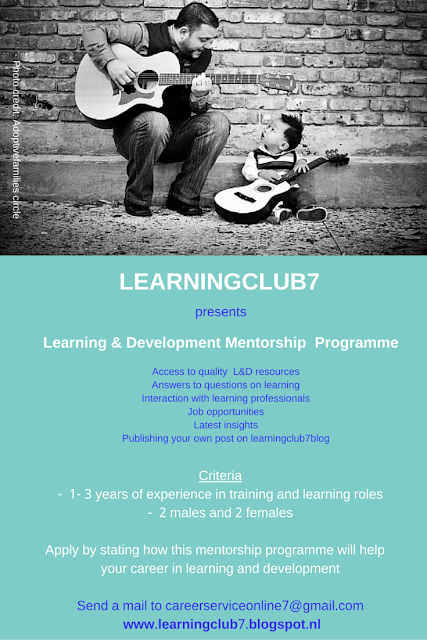
My motivation for the e-mentorship programme

Image
I have been working for the last ten (10) years in different roles from learning coordinator in the financial service industry to capacity building and training advisor for an international consulting firm to my current role as training specialist/consultant with a non-profit. It is time to give back from the wealth of knowledge and skills I have gained. That is the reason why I'm starting this e-mentorship programme.  You will be learning from my successes and mistakes but everything works out for good in all circumstances. I have taken a unique journey from core sciences to management with specific focus on learning so I understand a lot of what professionals go through in their journey and a word of advice can be very helpful.This is part of giving back; we can't grow unless we give back. The mentorship programme will be done in a virtual environment and I promise that we shall both learn from each other in many ways. I am also excited with support from HR directors a...

Learningclub7 Mentorship Programme

Image

Brain Centered Learning: Exploring the path

Image
Written by Bayo Adekola Photocredit -  katrinaallangba Everyone knows that the brain controls all activities in the body including learning . The goal of learning is first to remember what is taught, connect and then it can be applied. If you don't remember and connect with the knowledge, you will likely not apply it. I learnt recently about brain centered learning. I'm doing a lot of learning lately. Learning professionals should constantly learn. It is the first word in our title "learning"........: so it should come first. Here are the basic principles used in brain centered learning; the focus is to ensure recall and connection so that there is real life application. 1. Use emotions:  Who isn't moved by emotions?   Emotions draw from previous experiences and allow for comparison, analysis and facilitates thinking too. When you can reach out to previous experiences, learning just got exciting. 2. Assure repetition: Think of one song you d...

Experiential Learning : Another thought

Image
Written by Bayo Adekola Again I went through a refresher Training of Trainers (TOT) course and the whole topic of experiential learning was discussed. It brought up some questions for me as an individual and it surrounds the issue of where we all start learning from in different contexts. To break it down, at what stage of the experiential cycle is a  college student, recent graduate with little experience or working professional. I don't what to dabble into the learning styles which has confused many but is also a true reflection of who you are and how you think. College students I think that college students learn a lot of theories and analysis of what exists. The colleges teach the theoretical background required for application.In my opinion, I feel that students are at the stage of abstract conceptualisation then move to active experimentation through concrete experience and reflective observation. Recent graduate with no experience At this stage, the f...

Season's Greetings to all our Readers

Image